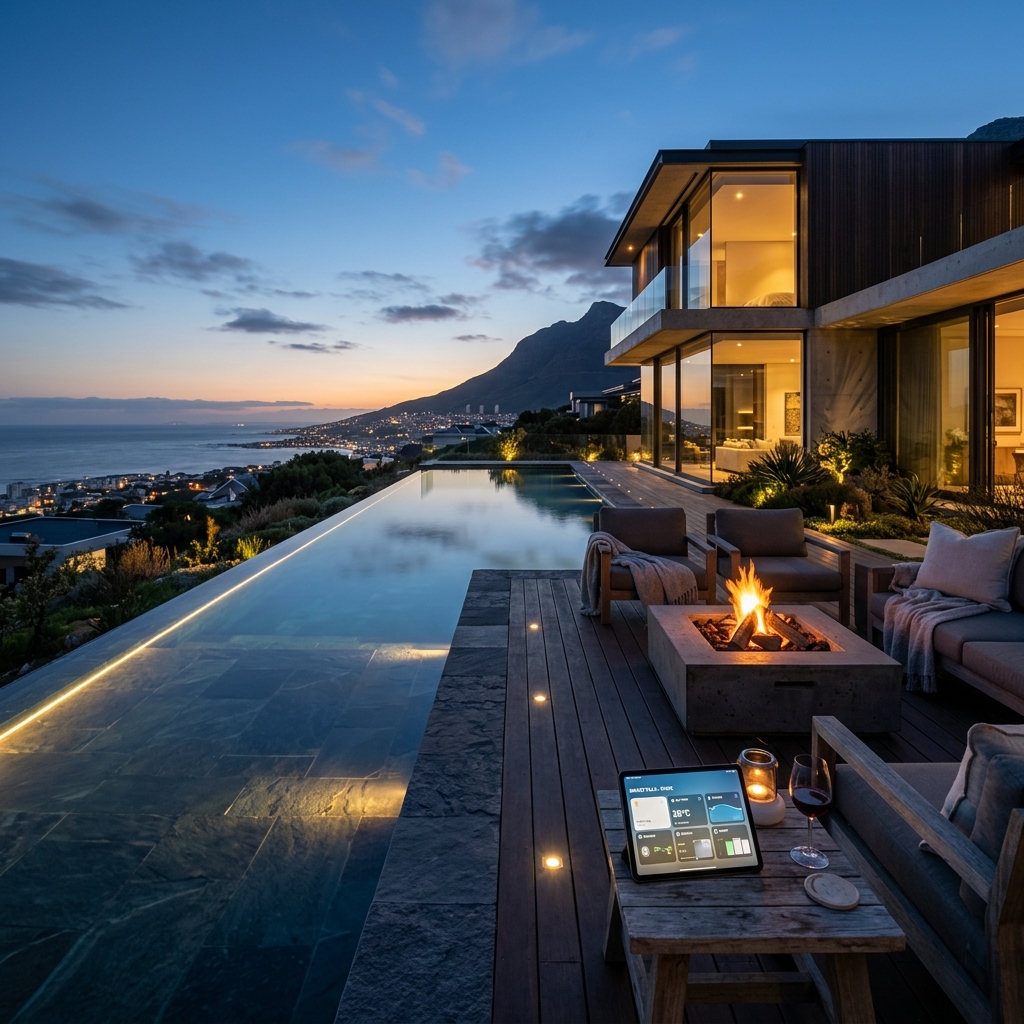
A short, practical guide to understanding how automation changes maintenance, safety and comfort around domestic pools.
Why automate your pool?
Pool automation takes over repetitive tasks, improves safety and keeps costs down. It combines sensors, controllers and user interfaces (apps, voice assistants) to make running the pool simpler and more reliable.
Simpler day-to-day management
- Remote control from a phone or tablet.
- Programmable scenarios (pre-heating before a swim, gradual evening lighting).
- Automatic notifications (maintenance, anomalies).
Example functions:
- Water temperature (automatic regulation).
- Smart filtration schedules based on water quality and how the pool is used.
- Lighting and jets for atmosphere.
Water quality and automatic maintenance
The sensors continuously measure pH, ORP (oxidation-reduction), temperature, salinity and turbidity. The controller can then:
- Adjust chemical dosing (chlorine, pH correctors).
- Run filtration cycles that match the conditions.
- Raise an alert when a parameter drifts.
The benefits: less chemical waste, better sanitary conditions and less human intervention.
Safety and prevention
Automation strengthens safety around the pool:
- Detection of presence or of a fall into the water.
- Locking and alarms on access points.
- Automatic control of covers and shutters.
- Emergency notifications on your phone, with the option of tying into alerting services.
These functions are particularly worth having for families with children, or for sites open to the public.
Savings and the environment
Optimised management brings savings: lower energy use (heating and pump), filtration matched to need, and leaks caught early.
The result: a lower energy bill, less water used and a smaller environmental footprint.
Installation advice and good practice
- Choose sensors and controllers that work together — open standards first.
- Plan a suitable, protected power supply and electrical enclosure.
- Test your scenarios in manual mode before automating them fully.
- Set up redundant alerts (SMS and push) for critical incidents.
- Keep a schedule for checking and calibrating the sensors.
Useful resources and links
- Connected-pool DIY forums and communities.
- Electrical safety standards for outdoor installations.
- Well-known manufacturers (controllers, sensors, automation).
Conclusion
Pool automation combines comfort, safety and efficiency. Done well, it cuts the time spent on maintenance, protects the people using the pool and makes substantial savings possible. For the best results, favour compatible equipment, professional installation and regular follow-up.
Ready to make your pool smarter? Start by listing what you need (safety, comfort, budget), then choose a solution that can grow with you.
🔧